AI Overview
Digital marketing strategy is the plan that decides who you are trying to reach and why, while execution is the day to day work of running ads, posting content, and sending emails. Businesses that focus only on execution often produce plenty of activity with little real growth, since no plan connects the actions to a goal. Building a strategy starts with a clear goal, a defined audience, and a customer journey mapped across channels, followed by consistent execution and regular review. Businesses in Vancouver and Toronto often partner with a digital marketing agency such as FirstChoice Media to build this plan and carry it out together.
Your team posts on Instagram three times a week. You are running Google ads. Your storefront finally has a proper website. And yet sales stay flat, month after month. This is one of the most common frustrations business owners bring to us, and it usually traces back to one gap: plenty of marketing activity, but no marketing strategy tying it together. Posting content and running ads is execution. Deciding who you are trying to reach, why they should choose you, and which channels deserve your budget is strategy. This article breaks down the difference, and walks through how to build a strategy that actually drives growth.
What Is the Difference Between Marketing Strategy and Execution?
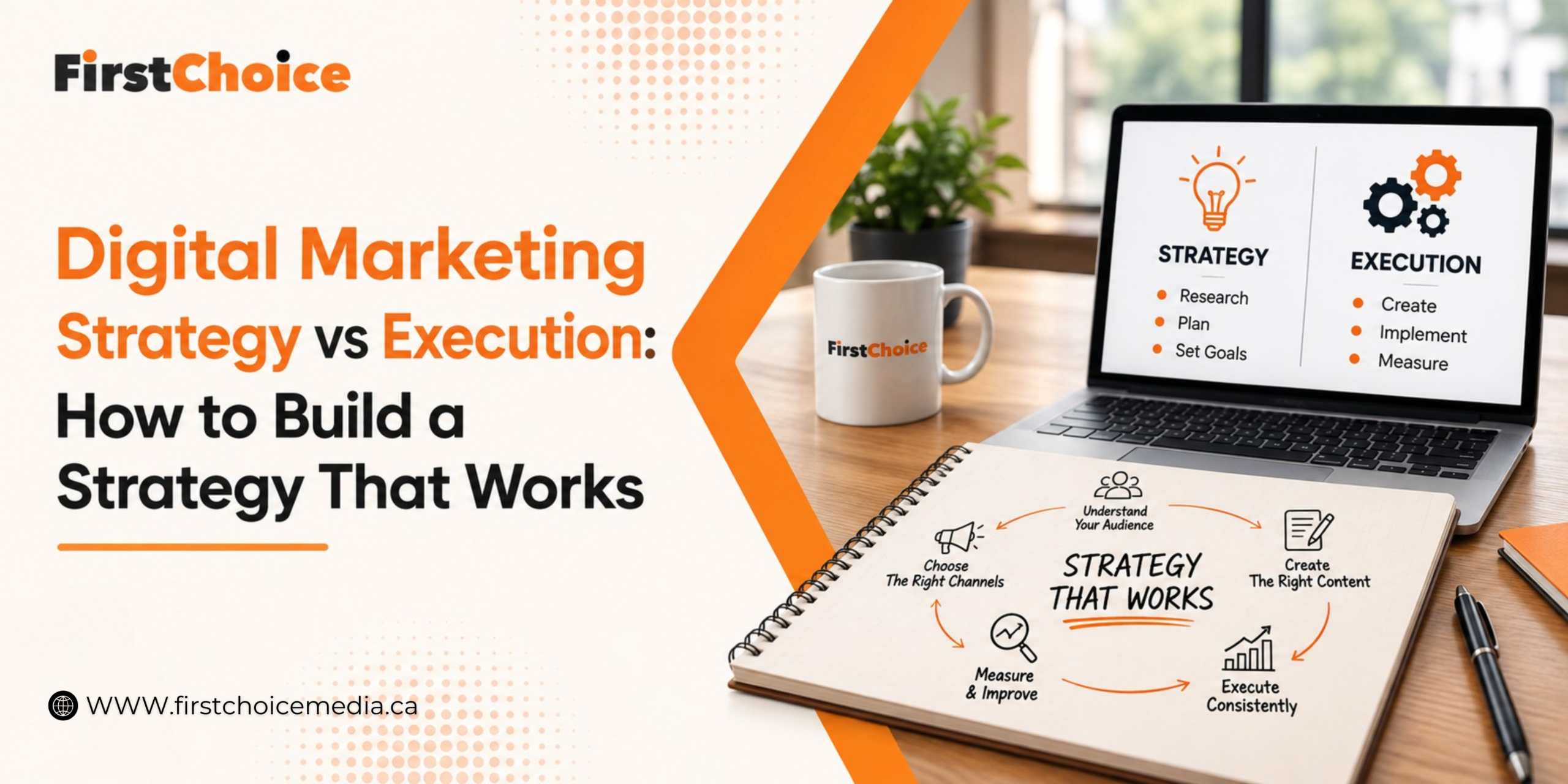
Marketing strategy is the plan behind your marketing efforts. It defines your target audience, your positioning against competitors, your goals for the coming quarter or year, and which channels deserve your time and budget. Execution is everything that happens after the plan: writing captions, designing ads, scheduling emails, and publishing blog posts. Confusing the two is common. A business owner sees a competitor posting daily on social media and assumes that activity alone builds a brand. Without a strategy behind it, that activity rarely turns into revenue.
- Strategy answers who you are targeting and why they should pick you over a competitor
- Strategy sets measurable goals, such as lead volume, cost per acquisition, or revenue targets
- Execution covers the daily tasks: social posts, ad creative, email sends, and content publishing
- Execution without strategy often produces activity that looks productive but does not move the goal
- Strategy without execution stays a plan on paper and never reaches your actual customers
Why Do So Many Business Owners Confuse Strategy With Execution?
Here is a scenario we hear often from business owners in Vancouver. A café owner hires someone to manage Instagram. Posts go out on schedule, and follower counts climb. But six months in, foot traffic has not changed, and the owner cannot explain why the effort has not turned into new customers walking through the door. The reason is simple. Nobody sat down first to define who the café was trying to reach, what made it different from three other cafés on the same block, or which platform its actual customers spend time on. The posting stayed consistent. The plan behind it never existed.
This pattern repeats across industries, not only in cafés and retail shops. A law firm runs Google ads without first deciding which practice area brings in the most valuable clients. A contractor posts project photos without a plan for turning followers into estimated requests. In each case, the missing piece is not effort. It is a strategy that gives the effort a direction to travel.
How Do You Build a Digital Marketing Strategy That Works?
- Define a clear goal for the next ninety days, such as a specific number of leads or a revenue target, not a vague wish to grow.
- Identify your actual audience using real data, not assumptions, pulling from Google Analytics, chat logs, or past customer conversations.
- Audit every channel you currently use and note what has driven real results in the last six months, not vanity metrics like follower counts.
- Map the customer journey from the first search to the final purchase, and note the point where prospects tend to drop off.
- Choose two or three channels that match where your audience already spends time, instead of spreading budget across every platform.
- Set a review schedule, monthly at minimum, to check performance against the original goal and adjust the plan as needed.
A side-by-side view makes the difference between the two easier to see:
| Factor | Marketing Strategy | Marketing Execution |
| Focus | Direction and decisions | Daily and weekly tasks |
| Time Frame | Quarterly or annual planning | Daily or weekly output |
| Owned By | Business owner or marketing strategist | Marketing team, freelancer, or agency staff |
| Example Actions | Setting goals, choosing channels, defining audience | Posting content, running ads, sending emails |
| Measured By | Revenue growth and market position | Output volume, engagement, and click-through rate |
SEO Freelancer vs SEO Agency
Once your strategy points toward SEO as a priority channel, the next decision is who carries it out. A freelancer and an agency both offer SEO services, but they work differently, and the right choice depends on your business size and how complex your SEO needs are.
-
- A freelancer usually works alone, which means faster communication but a narrower skill set
- An agency brings a team covering content, technical SEO, link building, and reporting under one roof
- A freelancer costs less upfront, though capacity is limited if your SEO needs grow quickly
- An agency scales with you, adding resources as your website, content, and campaigns expand
- Both can follow Google’s guidelines correctly; the real difference sits in range of skills and available time
| Factor | SEO Freelancer | SEO Agency |
| Team Size | One person handling all tasks | A team with specialists across content, technical work, and outreach |
| Availability | Limited to one person’s schedule and capacity | Broader coverage, less dependent on a single individual |
| Skill Range | Strong in specific areas, narrower overall | Wider range of expertise across SEO disciplines |
| Cost Structure | Lower hourly or project rate | Higher investment, though it covers more ground |
| Ideal For | A small site with one clear, focused project | Businesses with ongoing or multi-channel SEO needs |
What Growth Can You Expect When Strategy and Execution Work Together?
When the plan and the daily work point in the same direction, growth becomes easier to track and repeat.
- Marketing spend goes toward channels your actual audience uses, not channels that seem popular
- Content and ads carry one consistent message, instead of sounding different across platforms
- Results become easier to measure, because every action ties back to a stated goal
- Budget decisions get easier, since you can compare each channel against the same targets
- Your team, or your agency, spends less time deciding what to post next, since the plan already points the way
At FirstChoice Media, a digital marketing agency in Toronto and Vancouver, we start every new relationship with a conversation, not a proposal. We ask about your goals, your customers, and what has and has not worked before we suggest a single channel. Our team in Vancouver and Toronto builds the strategy first, then carries out the execution ourselves, so the plan and the daily work stay connected instead of drifting apart.
If your marketing activity has not turned into real growth, our team at FirstChoice Media can review your current channels and show you where the plan is missing. Book a consultation now.
FAQs
Yes. A strategy does not need a large budget. It needs a clear goal and an honest look at where your customers actually spend time, even for a business with one location.
A basic strategy can take one to two weeks to outline, depending on how much audience data you already have. Refining it happens continuously as you review results.
This depends on your time and skill set. Many business owners handle strategy themselves and bring in a freelancer or agency for execution, since daily tasks demand consistent time.
Jumping straight into execution, such as posting content or running ads, before defining a goal or audience. This leads to activity without measurable results.
Yes, and it should. A strategy built a year ago may not fit your business today. Regular review keeps it aligned with current goals and market conditions.