AI Overview
A Google penalty is a drop in search rankings caused by a manual review from Google’s team or by an automatic algorithm update. Common triggers include spammy backlinks, thin content, hidden text, and duplicate pages. Recovery starts with checking Google Search Console for a manual action notice, correcting the root cause, and, where needed, filing a reconsideration request. Business owners in Vancouver often work with a local SEO agency such as FirstChoice Media to diagnose the exact issue and rebuild rankings the right way.
Your website traffic dropped overnight, and nothing about your business changed. Bookings slowed down. Phone calls stopped coming in. You check Google Analytics and see a sharp line heading down, with no clear reason attached to it. This happens to business owners across Vancouver more often than people admit, and it usually points to one issue: a Google penalty. A penalty does not mean your business failed at anything. It means Google flagged a problem on your website that needs correcting. This article walks through what causes a penalty, how to spot one early, and the steps that bring your rankings back.
What Is a Google Penalty and How Do You Know Your Site Has One
A Google penalty happens when Google’s system, either a human reviewer or an automated update, decides your website works against its search quality guidelines. Once that happens, your pages drop in rankings, or they disappear from search results entirely. Two types exist. A manual penalty comes from an actual reviewer at Google who found a specific violation on your site, and you will see a notice about it. An algorithmic penalty happens without any direct message, usually following a core update, and you learn about it only through your traffic numbers.
- Organic traffic falls sharply within a few days, with no seasonal pattern behind it
- Google Search Console shows a manual action notice under Security and Manual Actions
- Pages that used to rank on page one drop off the results entirely
- Your brand name still shows up in search, but service and product pages do not
- Visitors leave your pages faster than before, and average time on page falls
What Causes a Google Penalty on Your Website
Most penalties trace back to practices that try to shortcut how search engines work. Some business owners make these mistakes without realizing it, often because an old developer handling their web design or a previous marketing vendor set things up years ago and left them unchecked.
- Paid or spammy backlinks pointing to your domain from unrelated or low quality sites
- Thin content pages that offer little useful information to the person reading them
- Duplicate content copied from other websites, or repeated word for word across your own pages
- Hidden text or keyword stuffing meant to trick search engines instead of helping readers
- A hacked website injecting malicious links or redirects you never approved
Here is how the two penalty types compare, side by side:
| Factor | Manual Action Penalty | Algorithmic Penalty |
| Trigger | A human reviewer at Google flags a specific violation | An automated system lowers rankings during a broader update |
| Notification | A message appears inside Google Search Console | No direct notice; a traffic drop is the first sign |
| Common Cause | Unnatural links, thin content, or cloaking | Weak content quality, poor user experience, low site authority |
| Typical Timeline | Days to weeks after a reconsideration request | Weeks to months, tied to the next algorithm update |
| Recovery Method | Fix the issue, then submit a reconsideration request | Improve content and technical health, then wait for reassessment |
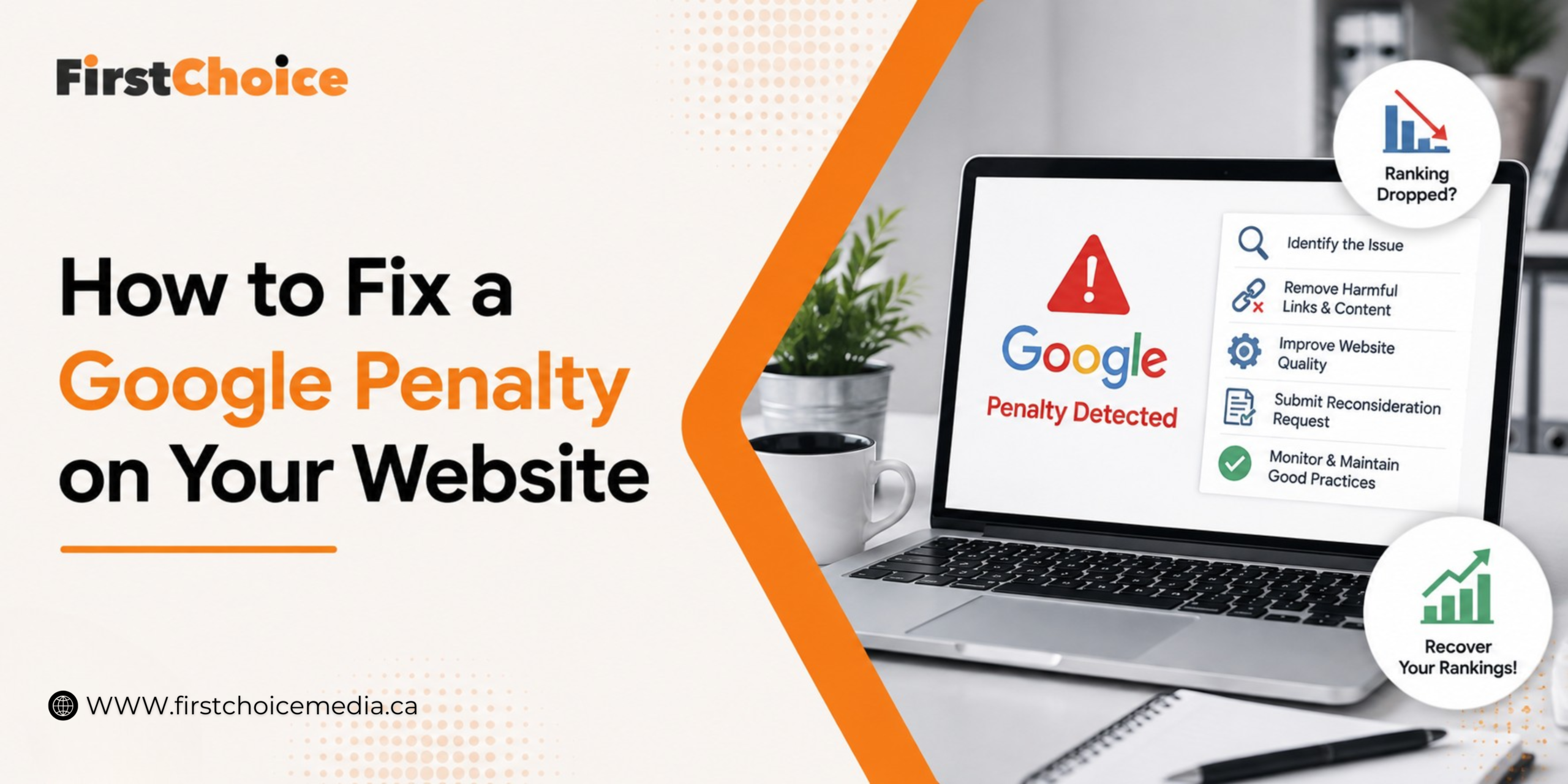
How to Fix a Google Penalty on Your Website
- Check Google Search Console first. Open the Manual Actions and Security Issues reports. If Google flagged something specific, this is where you will find it, along with the exact reason given.
- Review your backlink profile closely. Export your backlinks from Search Console or a tool such as Ahrefs, and look for spammy or unrelated domains linking to your site. Disavow the ones that look manipulative.
- Audit your content for thin or duplicate pages. Remove or rewrite any page that repeats existing content, adds no real value, or was built only to target a keyword.
- Fix technical issues that hurt user trust. This includes broken links, slow load times, hidden text, and redirect chains that were never meant to exist.
- Submit a reconsideration request for manual actions. Explain what caused the issue and the exact steps you took to fix it. Google reviews these requests and responds directly through Search Console.
- Monitor your rankings and traffic closely for the following weeks. Recovery is rarely instant, and watching the trend line tells you whether the fix actually worked.
How to Choose the Best SEO Agency in Vancouver
Vancouver has no shortage of digital marketing companies providing search engine optimization services, and most of them describe similar results on their websites. The difference shows up in how an agency actually works, not in what its homepage promises. A penalty recovery project needs someone who understands Google’s guidelines in detail, not someone who adds keywords and hopes the numbers improve.
- Ask for examples of penalty recovery work, not only traffic growth case studies
- Ask how they diagnose the root problem before recommending any fix
- Ask about their reporting process and how often you will hear from them
- Ask whether they follow Google’s Webmaster Guidelines strictly, without shortcuts that risk another penalty later
- Ask how the engagement is priced, and whether it is a flat project fee or an ongoing retainer
A quick side-by-side helps when you are deciding between fixing things yourself or bringing in help:
| Factor | Fixing It Yourself | Working With an SEO Agency in Vancouver |
| Time Required | Weeks of research and repeated trial and error | A structured audit, usually completed within days |
| Risk of Repeat Penalty | Higher, without full knowledge of Google’s guidelines | Lower, backed by experience recognizing earlier violations |
| Upfront Cost | No agency fee, though revenue drops during the downtime | An upfront investment that speeds the return to stable rankings |
| Ideal For | A small site with one clear, easy to trace issue | Businesses facing a complex penalty or ongoing SEO needs |
At FirstChoice Media, our SEO company in Vancouver starts every recovery project the same way: a full audit of your backlinks, content, and technical setup, before recommending anything. We have worked through manual actions and algorithm drops for businesses across British Columbia, and we explain what happened in plain language, not technical jargon. Our approach follows Google’s guidelines closely, because a quick fix that risks another penalty later does not help anyone.
If your rankings dropped and you cannot find a reason, our team at First Choice Media, a leading digital marketing company in Vancouver, can review your Search Console data and tell you what happened. Book a consultation with us today.
FAQs
Manual action recovery often takes a few weeks after you fix the issue and submit a reconsideration request. Algorithmic penalties take longer, sometimes a few months, since recovery depends on the next update.
Yes, for smaller sites with a clear issue, such as one bad backlink or a duplicate page. Larger or complex penalties usually need an experienced eye to trace every contributing factor.
Often close, though not always identical. Search results change constantly, and other sites may have moved up while you were addressing the penalty.
Not on its own. A redesign can cause temporary ranking drops if URLs change without proper redirects, but that is a technical issue, not a penalty.
Ask directly about their link building, local seo, and content practices. A trustworthy agency explains its process openly and avoids vague answers about special connections or shortcuts.