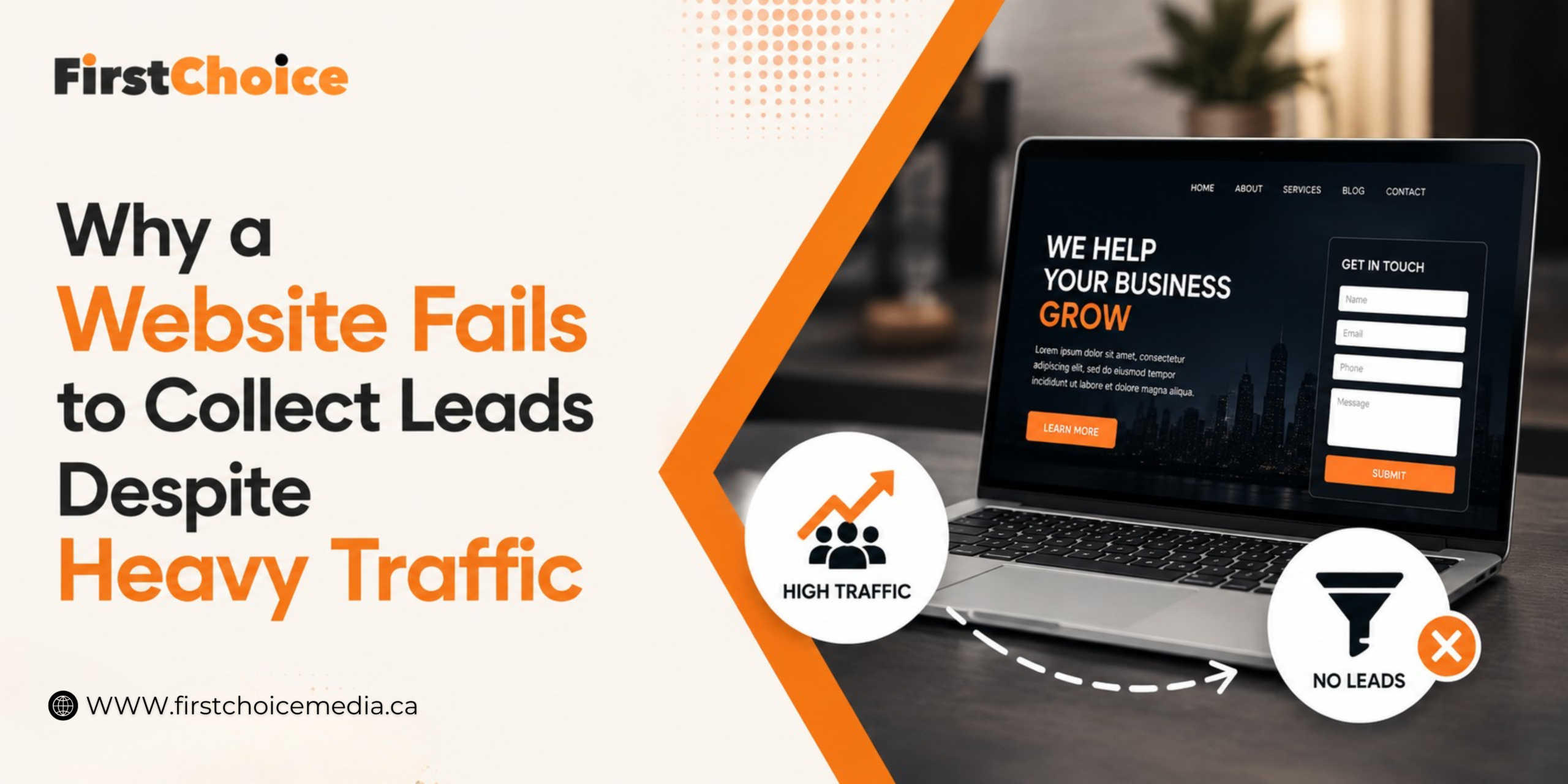
A website can bring in a large number of visitors and still fail to generate leads, because traffic and conversion measure two different things. A visitor becomes a lead only when a page removes friction, states its value clearly, and gives an easy next step. For a business in Toronto, this gap between visits and inquiries usually comes down to page speed, unclear calls to action, or a contact form that asks for too much information. Fixing the gap does not require more traffic. It requires a website built to convert the traffic already arriving.
Why Does a Website Get Traffic but No Leads?
Traffic and conversion are not the same measurement, though many business owners treat them as one. Traffic counts how many people visit a page. Conversion counts how many of those visitors take the action a business actually wants, such as filling out a form or making a call. Industry benchmarks in 2026 place the average website conversion rate between two and five percent across most industries, meaning most visitors leave without acting even on a well-built site. A site that fails to reach even that modest range usually has an identifiable reason behind it.
- A call to action that is hard to find, unclear, or repeated the same way on every page
- A page that takes longer than three seconds to load, since slow speed pushes visitors back to search results
- A contact form that asks for too much information before a visitor trusts the business
- No visible phone number, address, or proof that the business operates in Toronto
- A homepage that describes the company instead of the visitor’s problem
None of these issues show up in a traffic report. They only show up in the number of leads a business never receives.
What Separates a High-Converting Website From a Traffic-Only Website?
A website built only to attract visitors looks different from one built to turn visitors into leads, even when both sites cover the same industry. The difference sits in structure.
| Element | Traffic-Only Website | Lead-Generating Website |
| Call to Action | Generic, placed once, easy to miss | Clear, repeated at natural points, states the next step |
| Page Load Speed | Loads slowly on mobile devices | Loads within a few seconds on most connections |
| Contact Form | Long, asks for unnecessary details | Short, asks only for what is needed to follow up |
| Trust Signals | Few or no reviews, no local details | Reviews, service areas, and real contact information visible |
| Content Focus | Describes the business and its history | Speaks to the visitor’s problem and next step |
Note: This comparison reflects structure, not a personal opinion about design style. Both types of websites can look attractive, yet only one is built to move a visitor toward contact.
What Everyday Mistakes Cause Toronto Businesses to Lose Leads?
A business in the Greater Toronto Area rarely loses leads all at once. The pattern builds slowly, through small choices that seemed reasonable at the time.
- Updating a business address or phone number in one place but forgetting the website
- Placing the contact form below several sections of text a visitor never scrolls to see
- Running Google Ads that send visitors to a homepage instead of a page built for that specific service
- Ignoring how the site performs on mobile, even though most local searches in Toronto happen on a phone
- Publishing content once and leaving it unchanged for years while competitors update theirs
Each mistake seems small in isolation. Together, they explain why a website with steady traffic still produces an empty inbox.
What’s the Best Way to Get More Leads From My Website in Toronto?
The most reliable way to get more leads from a website in Toronto starts with fixing what already exists, before adding more traffic on top of it. A business that sends new visitors to a page with the same friction only repeats the same problem at a larger scale. The order matters. Fix the page first, then grow the traffic feeding it.
FirstChoice Media, a web development company in Toronto, works with businesses across Canada to build websites around this order. Our team reviews how visitors actually move through a page, then adjusts calls to action, load speed, and form length before touching the design for appearance alone. We treat a website as a working tool for the business, not a digital brochure, and we explain each change in terms of the visitor behavior it addresses.
| Website Element | What It Should Do | Common Problem It Fixes |
| Above-the-Fold Message | State what the business does and for whom, within seconds | Visitors leaving before understanding the offer |
| Call to Action | Give one clear next step, repeated at natural points | Visitors unsure what to do after reading |
| Mobile Performance | Load fully and function on a phone within a few seconds | Visitors abandoning the page on slow connections |
| Contact Form | Ask only for essential details | Visitors dropping off before finishing a long form |
| Local Proof | Show service areas, reviews, and real contact details | Visitors uncertain if the business serves their area |
How Can a Business Check if Its Website Is Actually Working?
A business does not need advanced tools to get a first honest read on website performance. A few checks reveal most of the story.
- Divide the number of leads received in a month by the number of visitors, to see the actual conversion rate
- Compare mobile performance against desktop performance, since mobile visitors usually convert at a lower rate
- Check how many visitors start the contact form but never submit it
- Review which pages visitors leave from most often, since that page usually holds the problem
- Ask a person unfamiliar with the business to find the contact form within ten seconds
These checks take a little time. What they reveal decides whether the next step is a small fix or a bigger rebuild.
What To Do For Your Website?
A website does not need a full rebuild to start producing more leads. FirstChoice Media, a website design company in Toronto, works with businesses to review what a site currently does well and where it loses visitors. Reach out to our team to talk through what a stronger-converting website could look like for your business, before any commitment is made.
FAQs
Not by itself. Traffic and lead generation depend on different factors, and a site with weak conversion elements can receive visitors without converting them.
Most small business websites see two to five percent of visitors convert into leads, with three to five percent considered strong for service businesses.
A page should load within a few seconds, since slower load times push visitors back to search results before the page fully appears.
No. A shorter form with only essential fields usually completes more often than a long form asking for unnecessary details.
Yes. A well-structured website with clear calls to action and strong local content can generate leads through organic search alone.
A quarterly review helps catch drop-off points early, rather than waiting a year to notice a decline in inquiries.